This has been a year of superlatives. AIG: the biggest government bailout. Lehman: the biggest bankruptcy. Russia: the worst financial crisis since the country defaulted a decade ago (and now home to the world's cheapest stocks). What's more, the Dow Jones industrial average dropped to its lowest close in more than two years.
The Consumerist posted a list of the 10 Biggest Chapter 11 Bankruptcies in U.S. History (culled from a CNBC slideshow and Bankruptcydata.com). Drum roll, please:
10. United Airlines
Assets: $25.2 billion
Date Filed: Dec. 9, 2002
9. Pacific Gas and Electric
Assets: $29.8 billion
Date Filed: April 6, 2001
8. Global Crossing
Assets: $30.2 billion
Date Filed: Jan. 28, 2002
7. Refco
Assets: $33.3 billion
Date Filed: Oct. 17, 2005
6. Financial Corp. of America
Assets: $33.9 billion
Date Filed: Sept. 9, 1988
5. Texaco
Assets: $35.9 billion
Date Filed: April 12, 1987
4. Conseco
Assets: $61.4 billion
Date Filed: Dec. 18, 2002
3. Enron
Assets: $63.4 billion
Date Filed: Dec. 2, 2001
2. Worldcom
Assets: $103.9 billion
Date Filed: July 21, 2002
1. Lehman Bros.
Pre-Bankruptcy Assets: $639 billion
Date Filed: Sept. 15, 2008

Showing posts with label Trivia - Business. Show all posts
Showing posts with label Trivia - Business. Show all posts
Sunday, December 14, 2008
Friday, September 12, 2008
Accenture > Accent on the future.
Accenture originated as the consulting division of Arthur Anderson. Its origin goes back to 1953, when GE asked Arthur Andersen to undertake a feasibility study about payroll processing and manufacturing automation using computers. In 1989, that division split from Arthur Andersen and began using the name Andersen Consulting. On January 1, 2001, Andersen Consulting adopted its current name, "Accenture". The word "Accenture" is derived from "Accent on the future". Although a marketing consultancy was tasked with finding a new name for the company, the name "Accenture" was chosen by an employee from the Oslo office, as a result of an internal competition. Arthur Anderson was one of the member of Big 5 once upon a time until ENRON happened. The fiasco of ENRON was one of major turnarounds in the business of the accounting firms and this event actually led to the separation of Consulting business from the accounting business. Also Sarbanes Oxley Act of 2002 also came into force because of this financial breakdown. The greater-than sign over the 't' shows that the company is looking to the future. The mark is also an accent mark in music.Tiger Woods is the brand ambassador of the company. The campaign uses the phrase "Go On. Be a Tiger." as its advertisment baseline. Tagline for the company is High Performance. Delivered.

Monday, September 8, 2008
History of Goldman Sachs
Goldman Sachs was founded in 1869 by German Jewish immigrant Marcus Goldman. The company made a name for itself pioneering the use of commercial paper for entrepreneurs and was invited to join the New York Stock Exchange in 1896. It was during this time that Goldman's son-in-law Samuel Sachs joined the firm which prompted the name change to Goldman Sachs.
In the early 20th Century, Goldman was a major player in establishing the Initial Public Offering market. It managed one of the largest IPO's to date, that of Sears, Roebuck and Company in 1906.
In 1929, it launched the Goldman Sachs Trading Corp., a closed-end mutual fund with characteristics similar to that of a Ponzi Scheme. The fund failed as a result of the Stock Market Crash of 1929, hurting the firm's reputation for several years afterward.
In 1930, Sidney Weinberg assumed the role of Senior Partner and shifted Goldman's focus away from Trading and towards Investment Banking. On the back of Weinberg, Goldman was lead advisor on the Ford Motor Company's IPO in 1956, which at the time was a major coup on Wall Street.
Gus Levy joined the firm in the 1950s as a well known securities trader, which started a trend at Goldman where there would be two powers generally vie for supremacy, one from investment banking and one from securities trading. Due to Weinberg's heavy influence at the firm, it formed an Investment Banking Division in 1956 in an attempt to spread around influence and not focus it all on Weinberg.
In 1969, Levy took over as Senior Partner from Weinberg, and built Goldman's trading franchise once again. It is Levy who is credited with Goldman's famous philosophy of being "long term greedy," which implies that as long as money is made over the long term, trading losses in the short term are not to be worried about. That same year, Weinberg retired from the firm.
Another financial crisis for the firm occurred in 1970, when the Penn Central Railroad Company went bankrupt with over $80 million in commercial paper outstanding, most of it issued by Goldman Sachs. The bankruptcy was large, and the resulting lawsuits threatened the partnership capital and life of the firm. It was this bankruptcy that resulted in credit ratings being created for every issuer of commercial paper today by several credit rating services.[
John Weinberg (the son of Sidney Weinberg), and John C. Whitehead assumed roles of Co-Senior Partners in 1976, once again emphasizing the co-leadership at the firm. One of their most famous initiatives was the establishment of the 14 Business Principles are still used to this day.
In the 1980s, the firm made a major move by acquiring J. Aron & Company, a commodities trading firm which merged with the Fixed Income division to become known as Fixed Income, Currencies, and Commodities. J. Aron was a major player in the coffee and gold markets, and the current CEO of Goldman, Lloyd Blankfein, joined the firm as a result of this merger.
In 1986, the firm formed Goldman Sachs Asset Management, which manages the majority of its mutual funds and hedge funds today. In the same year, the firm also underwrote the IPO of Microsoft, advised General Electric on its acquisition of RCA and joined the London and Tokyo stock exchanges. 1986 also was the year when Goldman became the first United States bank to rank in the top 10 of Mergers and Acquisitions in the United Kingdom.
One of the largest events in the firm's history was its own IPO in 1999. The decision to go public was a tough one that the partners debated for decades. In the end, Goldman decided to offer only a small portion, 12% of the company to be held by the public. Henry Paulson became Chairman and Chief Executive Officer of the firm. Hull Trading Company, one of the world’s premier market-making firms, was acquired by Goldman in 1999 for $531 million.
In the early 20th Century, Goldman was a major player in establishing the Initial Public Offering market. It managed one of the largest IPO's to date, that of Sears, Roebuck and Company in 1906.
In 1929, it launched the Goldman Sachs Trading Corp., a closed-end mutual fund with characteristics similar to that of a Ponzi Scheme. The fund failed as a result of the Stock Market Crash of 1929, hurting the firm's reputation for several years afterward.
In 1930, Sidney Weinberg assumed the role of Senior Partner and shifted Goldman's focus away from Trading and towards Investment Banking. On the back of Weinberg, Goldman was lead advisor on the Ford Motor Company's IPO in 1956, which at the time was a major coup on Wall Street.
Gus Levy joined the firm in the 1950s as a well known securities trader, which started a trend at Goldman where there would be two powers generally vie for supremacy, one from investment banking and one from securities trading. Due to Weinberg's heavy influence at the firm, it formed an Investment Banking Division in 1956 in an attempt to spread around influence and not focus it all on Weinberg.
In 1969, Levy took over as Senior Partner from Weinberg, and built Goldman's trading franchise once again. It is Levy who is credited with Goldman's famous philosophy of being "long term greedy," which implies that as long as money is made over the long term, trading losses in the short term are not to be worried about. That same year, Weinberg retired from the firm.
Another financial crisis for the firm occurred in 1970, when the Penn Central Railroad Company went bankrupt with over $80 million in commercial paper outstanding, most of it issued by Goldman Sachs. The bankruptcy was large, and the resulting lawsuits threatened the partnership capital and life of the firm. It was this bankruptcy that resulted in credit ratings being created for every issuer of commercial paper today by several credit rating services.[
John Weinberg (the son of Sidney Weinberg), and John C. Whitehead assumed roles of Co-Senior Partners in 1976, once again emphasizing the co-leadership at the firm. One of their most famous initiatives was the establishment of the 14 Business Principles are still used to this day.
In the 1980s, the firm made a major move by acquiring J. Aron & Company, a commodities trading firm which merged with the Fixed Income division to become known as Fixed Income, Currencies, and Commodities. J. Aron was a major player in the coffee and gold markets, and the current CEO of Goldman, Lloyd Blankfein, joined the firm as a result of this merger.
In 1986, the firm formed Goldman Sachs Asset Management, which manages the majority of its mutual funds and hedge funds today. In the same year, the firm also underwrote the IPO of Microsoft, advised General Electric on its acquisition of RCA and joined the London and Tokyo stock exchanges. 1986 also was the year when Goldman became the first United States bank to rank in the top 10 of Mergers and Acquisitions in the United Kingdom.
One of the largest events in the firm's history was its own IPO in 1999. The decision to go public was a tough one that the partners debated for decades. In the end, Goldman decided to offer only a small portion, 12% of the company to be held by the public. Henry Paulson became Chairman and Chief Executive Officer of the firm. Hull Trading Company, one of the world’s premier market-making firms, was acquired by Goldman in 1999 for $531 million.
Thursday, June 5, 2008
Some Interesting facts about Vijay Mallya
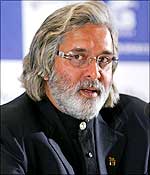
Some Interesting things about Vijay Mallya that you may love to know :
* He did his schooling at La Martiniere Boys', Calcutta in Kolkata and completed his degree from St. Xavier's College, Calcutta under Calcutta University.
* He started working while in college for Rs.400 a month in his fathers' company.
* His father Vittal Mallya died in 1983 and Vijay Mallya became the chairman of UB Group at an age of 28 . Due to his playboy image the media said:" a playboy has taken over ub"
* He married air-hostess sameera in 1986 whom he met on-board but they were divorced later in 1992.Sameera is the mother of his son Sidhartha (born 1987).
* He later married Rekha, a coorgi girl. Mallya has two daughters leana and tanya out of this marriage.
* He owns the company, United Racing and Bloodstock Breeders (URBB) which has interests in horse racing.
* Mallya has a home in 6, Bulkeley Avenue, Sausalito, California, 94965, USA.
* He has a private yacth, Indian Empress.
Read more about him @ wikipedia Rediff.com
Monday, June 2, 2008
Nooyi Trumps Buffett in pays
Ms Indra Nooyi,the Indian origin CEO of Pepsico,earn over 81 times more than the world richestman,Mr Warran Buffett,in term of the annual pay packet,according to data complied by search firm equilar for the New York Times.
Ms nooyi received an annual compensation to the tune of $14.74 million in 2007 as compared to $0.18 million draws by Mr Buffett who heads berkshire hathway,which is into life insuranceand annuity sales,amongs others.
Ms nooyi received an annual compensation to the tune of $14.74 million in 2007 as compared to $0.18 million draws by Mr Buffett who heads berkshire hathway,which is into life insuranceand annuity sales,amongs others.
Monday, May 26, 2008
$$ Nicknames of the US Dollar $$

The colloquialism buck (much like the English "quid") is often used to refer to dollars of various nations, including the U.S. dollar. This term, dating to the 18th century, may have originated with the colonial fur trade. Greenback is another nickname originally applied specifically to the 19th century Demand Note dollars created by Abraham Lincoln to finance the costs of the Civil War for the North. The original note was printed in black and green on the back side. It is still used to refer to the U.S. dollar (but not to the dollars of other countries).
Grand, sometimes shortened to simply G, is a common term for the amount of $1,000. The suffix K (from "kilo-") is also commonly used to denote this amount (such as "$10K" being pronounced "Ten kay" to mean $10,000). Banknotes' nicknames are usually the same as their values (such as five, twenty, etc.) The $5 bill has been referred to as a "fin" or a "fiver" or a "five-spot;" the $10 bill as a "sawbuck," a "ten-spot," or a "Hamilton"; the $20 bill as a "double sawbuck," a "twomp," a "twenty-banger," or a "Jackson;" the $1 bill is sometimes called a "single," the $2 bill a "deuce" or a "Tom," and the $100 bill is nicknamed the hunsky, a "Benjamin," "Benjie," or "Frank" (after Benjamin Franklin, who is honored on the note), or a C-note (C being the Roman numeral for 100) or a Century Note. Occasionally these will be referred to as "dead presidents," although neither Hamilton ($10) nor Franklin ($100) was President. $100 notes are occasionally referred to as 'large' in banking ("twenty large" being $2,000, etc.). The newer designs are sometimes referred to as "Bigface" bills.
Source - wikipedia
Thursday, May 22, 2008
Mark Zuckerberg : Facebook to Forbes !!!!!!!!
 Here are some interesting things you wanted to know about FACEBOOK and its founder Mark Zuckerberg, who is also named as the "World's youngest self-made billionaire" by Forbes .
* Mark Elliot Zuckerberg launched facebook from his Harvard dorm room on February 4, 2004.
* Zuckerberg attended Harvard University and was enrolled in the class of 2006.
* "The Facebook",was originally located at thefacebook.com, in February 2004. Later dropped 'The' from its name after purchasing the domain name facebook.com in 2005.
* On September 5, 2006, Facebook launched News Feed, a list of what friends were doing on the site.
* Microsoft announced on October 24, 2007 that it purchased a 1.6% share of Facebook for $246 million.
* In March 2008, Forbes.com ranked Zuckerberg as #785 on its rich list, citing his net worth as $1.5 billion.
* Facebook has won the People's Voice Award" from the Webby Awards in 2008.
* Facebook has more than 70 million active users worldwide.
Some controvercies :
* Zuckerberg's Harvard classmates, Divya Narendra, Cameron Winklevoss, and Tyler Winklevoss, claim they hired him to finish the code on their website, ConnectU and that he stole their idea, design, business plan, and source code.
* E-mails verified by the Chicago Tribune suggest that Zuckerberg might have taken many ideas for Facebook from Aaron J. Greenspan's houseSYSTEM website.
Subscribe to:
Posts (Atom)